
For a perhaps more convenient reading experience, you might also download this text as pdf HERE !
© 2026 Dr Lothar Riemenschneider
FiniTesti Publishing, 411, Beach Road
EH39 4HL, North Berwick/East Lothian – Scotland/United Kingdom
It often seems to me that the actual situation in Iran is not being presented or disseminated, especially the fact that, as in more or less every country, there might not be clear, “unified fronts”.
That it might not be „the People“ versus „the Mullahs,“ but rather that it might be more “complicated”.
It seems quite clear that a significant portion of the „people“ are fed up with the hypocrisy and the disconnect from reality of the „Islamic Revolution,“ which hardly ever had the support of any significant part of the „people“.
There had been increasing demonstrations against the monarchy and its pomp toward the end of the 1970s, but nowhere was there a majority of the „people“ who wanted to exchange this for an „Islamic Republic“.
Rather, this coup had been orchestrated behind the backs of “the People” by „interested circles“ abroad, particularly from the „Communist world“ and parts of the „Arab/Islamic world“ who were ready to install a so-called „Islamic“ (=Arab) „republic“ that has nothing to do with Persia, its history, or its multi-ethnic/multi-religious people.
This „government“—although polls indicate it has the support of at most a quarter of the population—is unfortunately more stable than is assumed or widely reported in the West.
The weak points appear to lie elsewhere.
The „encouragement“ for „the people“ to „continue fighting“ seems to be divorced from reality and this might be provoking tens of thousands of senseless death tolls.
The apparent „stability“ of the state is primarily due to the so-called „Revolutionary Guards“—installed by Khomeini, but long since operating independently, brutally oppressing the „people“ and yet not controlled by the „Islamic“ governments.
Without these brutalized „Revolutionary Guards,“ the „regime“ would likely be finished. No one, except for a few „devout“ hardliners, takes their empty rhetoric seriously anymore.
A crucial weak point could lie in the inherent mendacity and inconsistency of the „Revolutionary Guards“, and this may also be one of the reasons why Trump has (for now) not implemented his promises to „help the people“, as the true state of affairs may only have become clear to him now.
Generally speaking, it is striking how much so-called „reporting journalism“—including in the case of Trump and many others— is distorted in any „criticism“ of „ruling powers“ – fixated on and „criticized“ the so-called „ruling class“ -, yet the supposedly glorious and oppressed „people“ are hardly ever (critically) examined anywhere – without which but the „ruling class“ couldn’t exercise their „rule“ in the first place…
But the alleged or so-called „left“ needs its stories and fairy tales about the supposedly „innocent,“ „poor,“ „oppressed“ „people“.
Perception or questioning on double-mindedness, collaboration, „egoism“ or simply self-preservation, „tacit“ consent by the glorious, heroic „people“ are unwelcome in the „Free Press“.
„The people,“ who overwhelmingly or in their majority voted for Trump, from such “standpoints”, can only be „misguided“; there are no valid reasons for the election allowed.
„The People“ must be “led back” to the „right path“ with a.o. or mainly the result that the „Democrats“ don’t have to address their massive mistakes or face any critical questions.
Otherwise, they couldn’t install and praise such a disgusting, deceitful, and dangerous figure as the Islamist-Terrorist-in-mind Mamdummy of NYC.
The ”Revolutionary Guards” : part of “The People” – which but they kill to defend their privileges, and: –“Useful” and useless idiots as “representatives of The People” of so-called “democracies”
Everyone knows, for example, the „Rich Kids of Tehran,“ whose lifestyle—similarly „glamorous“ to that of the „leftist“ Mamdummy—most people yearn for: these kids are essentially members of the families of masterminds and butchers of the „Revolutionary Guard.“
They are not „against the people,“ but rather PART of the „people“.
„The people“ would like to live much like the „kids“; they clearly don’t want „communism“ because no „people“ in the entire world are as stupid and utterly idiotic as a few perpetually vocal „leftists“ and „communists“ the „atheists“ who were also stupid enough in 1979 to support the „Islamic leader“ and, as a reward, were the first to end up in the torture chambers.
But useful idiots, „leftists,“ are too stupid to learn—otherwise, they wouldn’t be „leftists“.
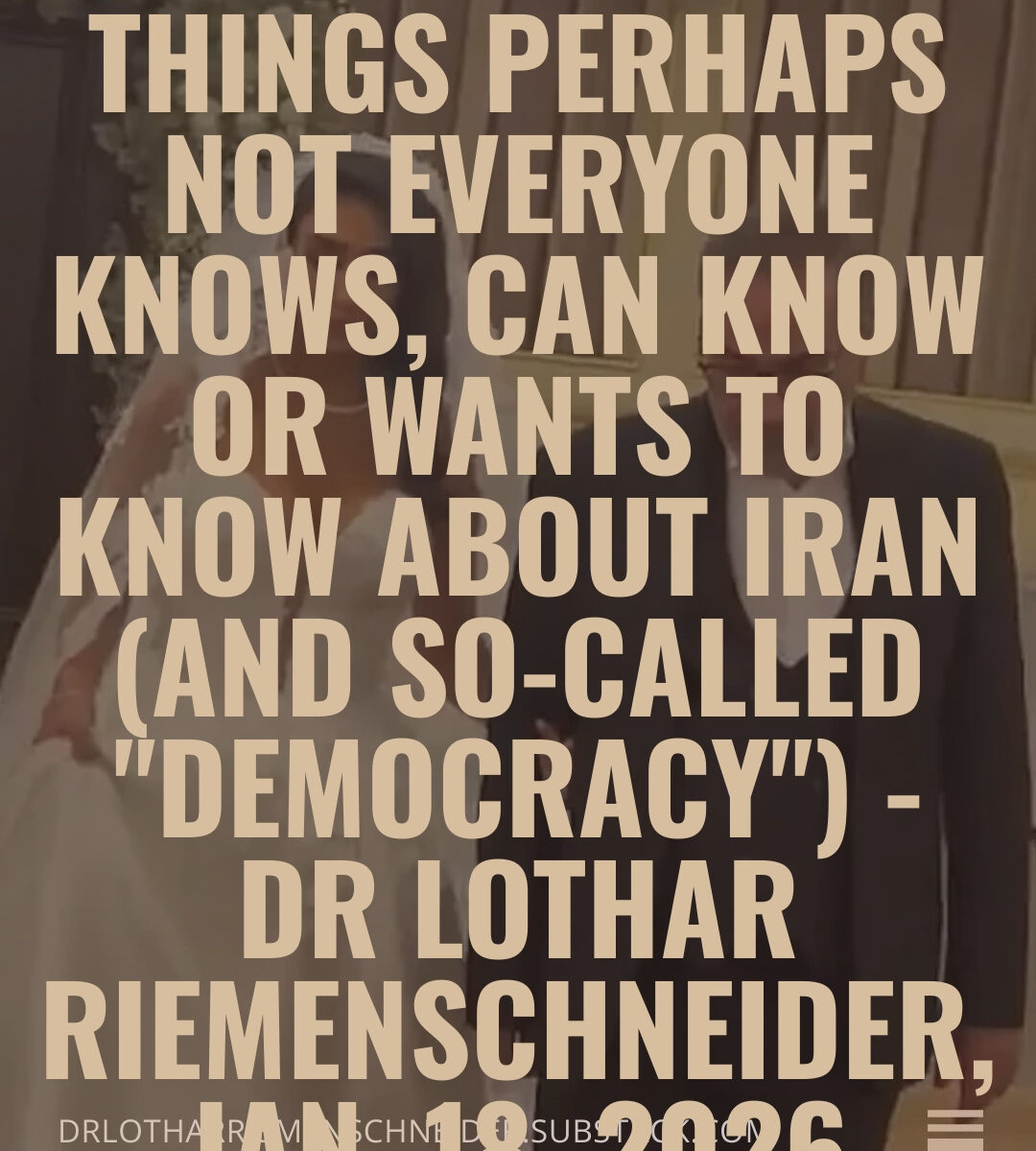
Many might remember the wedding in April 2025 of Fatemeh Shamkhani, a beautician trained in London, who, in a luxury hotel in Tehran, was escorted to her groom by her father, Ali Shamkhani, wearing a strapless dress: this father is a former general in the Navy of the „Revolutionary Guards“.
The vast majority of the Iranian people yearn for a life at least somewhat similar to this: and certainly not for any form of „communism“ which in reality is hardly distinguishable from „Islamism“: both are truly nihilistic, contemptuous of life, freedom, and humanity.
The „left,“ due to their incompetence, simply cannot grasp or accept that „capitalism,“ which in many ways also can have a contemptuous effect on humanity, is always preferred by the clear „majority“ over „socialism“—since „capitalism“ as a whole undoubtedly provides a better life for everyone including the poorest, than any supposed „alternative“.
„Capitalism“ can and should, of course, as well be criticized—but its violent „abolition“ does not constitute or support „criticism“ at all; rather, it destructively and arrogantly stifles any constructive criticism in its infancy.
Meanwhile, the „revolutionary guards“ outwardly act as if they are defending the pseudo-„religious“ festering sore of the „clergy“, but in reality, they, like „the People,“ have long since had enough of that mendacious “religion”.
The „Revolutionary Guards“ keep the „people“ at bay from the deceitful „religious leaders“ but largely live the „Western“ lifestyle themselves, just like the Shah’s family, and as „the People“ desire.
They outwardly chant „Death to the USA, Death to Israel,“ yet their leaders have long owned land in the „West“ and live the very life they publicly condemn. They are fighting against „the People“ who want to live similarly because they want to defend their privileges.
The “Revolutionary Guard”, the bodyguard of the mullah dictatorship, has built a state within a state in Iran.
It is the dominant force and would be ready to act even if the mullahs were gone. For their luxurious lifestyle, the Revolutionary Guards—as PART of „the people,“ as coming FROM „the people“—take on everything, including massacres of their own population.
The sons and daughters of their commanders lead extravagant lives of luxury and security in Europe, the USA, and Australia.
They open fire on the children of their compatriots in Iran.
The Revolutionary Guards brutally suppressed the uprising of recent weeks in the country. The protests were stifled.
First, they cut off internet and telephone connections, then they turned the streets of Iran’s major cities into battlefields.
Armed with machine guns mounted on pickup trucks, they opened fire on the demonstrators. Thousands died.
Hadi Ghaemi, director of the “Center for Human Rights” in Iran, speaks of a „massacre like in a war zone“.
The trigger for the uprising at the end of December was indeed a devastating economic crisis, but it quickly became about much more than inflation. The population chanted slogans like „Down with the regime,“ „Down with Khamenei“:
Ali Khamenei, in power since 1989, almost 87 years old, is suffering from cancer.
He survived the 12-day war in June, when Israeli and American fighter jets attacked Iran, terrified, in a bunker deep underground. His days are numbered. Not only because the theocracy in Iran has outlived its usefulness, but also because his bodyguards have long since been operating like a state within a state.
A slow-motion military coup is underway behind the scenes. The brutal repression of this uprising has brought it into sharp focus. The scenario of an open takeover by the Revolutionary Guards is a real possibility.
The US could play a similar role to the one in Venezuela. “The leadership cadres could oust Khamenei and negotiate with Donald Trump so that the US would end the sanctions and thus stabilize the economy,” says Ali Alfoneh of the “Arab Gulf States Institute” Think Tank.
But many “observers” are also skeptical that the hardliners would enter into an alliance with the US. – – For example, Danny Citrinowicz, former head of the Iran division of Israeli military intelligence, says: “If the Revolutionary Guard comes to power, there is a risk that all restraint will be abandoned, nuclear armament will be accelerated, and an even more confrontational course will be pursued.”
“Questions” like these are likely the underlying reason why Trump, after his initial threats, is not “following through” but is instead assessing the situation first.
More capable politicians—who don’t rely on figures like Wittkoff as “negotiators”—would have explored all of this beforehand. For this to happen, however, one would have to hire and retain employees who think and act clearly, are informed, and independently—who would then also have well-founded opinions of their own and might contradict the Lord of the Manhood, Trump:
That’s not what the orange-clad clown wants, who was „elected“ by the glorious „people“ in a glorious „democracy“…
After all, these troops control the Iranian nuclear program, as well as the country’s drone and missile industries.
With 200,000 men under arms, they are the decisive military power. They possess ground troops, naval forces, and air forces.
They have a foreign branch that is entrenched with 19 militias and terrorist groups throughout the Middle East.
Hundreds of thousands of men and women of the Basij militia are also subservient to them. These are “volunteer thugs” from “The People” in civilian clothing who use motorcycles and batons against demonstrators or act as a morality police, monitoring the population and arresting those deemed to be misbehaving.
This militia, for example, was the one that killed Mahsa Amini three years ago because of an allegedly improperly worn headscarf, which led to major uprisings in the country – especially among the young population.
Up to nine billion dollars a year flow from the state budget into the coffers of the Revolutionary Guards, representing almost forty percent of defense spending. And this is just one of their sources of income – and by no means the most lucrative.
Their specialty is smuggling, primarily of crude oil.
The proceeds—most recently amounting to around 60 billion US dollars annually despite the sanctions—flow almost exclusively into the coffers of the Revolutionary Guard.
They profited from Donald Trump’s policy of „maximum pressure.“
„The sanctions imposed by the US and its allies have weakened the Iranian population, but at the same time have created unprecedented opportunities for the Revolutionary Guard,“ emphasizes Narges Bajoghli, Professor of Middle Eastern Studies at Johns Hopkins University.
They built a system of informal economy that made it possible to circumvent the sanctions. „The Revolutionary Guard has now crushed this uprising with an iron fist, as they have the most to lose,“ says Afshon Ostovar, who teaches at the US Naval Postgraduate School and has authored a standard work on the Revolutionary Guard.
He calls them the „key to Iran’s future“ because they occupy the country’s central positions, both militarily and economically. Their commanders have amassed fortunes through corruption and smuggling.
„They have fat bank accounts abroad and opulent houses in Iran,“ says Ostovar. The Revolutionary Guards also control the drug trade, which is one reason why Iran is so intertwined with South American states. Alcohol sales are also handled by the Ayatollah’s guards.
From the very beginning, the „Pasdaran,“ as they are called in Farsi, have been a pillar of the regime.
Shortly after seizing power in 1979, Ruhollah Khomeini formally established the organization to protect himself against a potential army coup.
Now, however, their power surpasses that of the spiritual leader. „We are at the peak of our operational readiness“, announced Majid Mousavi, the commander of the air force, a few days ago.
„We are ready for an attack by America and Israel.“ „Since the war in June, we have massively increased our missile production.“ Such statements show where the power lies in the country.
Restructuring the Leadership: The „Revolutionary Guards„
The “Revolutionary Guards” though had also been weakened by the “12-day war” in summer 2025.
As Israel is long aware of the dangerous “Guards”, with a bunch of their leading commanders killed, afterwards they had to reorganize their leadership.
The second tier rose to prominence: 65-year-old Mohammad Pakpour, who most recently commanded the ground forces, was appointed commander. His deputy, appointed only at the end of December, was 67-year-old Ahmad Vahidi, considered “the new strongman” (i.e. most reckless piece of shit) and a “hardliner” notorious for his brutality and repression.
„This reshuffle is an indication that, despite everything, Khamenei still retains some power in the country, because he elevated Vahidi to this position“ says Kian Tajbakhsh, a lecturer at Columbia University and a former representative of the reformist forces in Iran, who was imprisoned during the 2009 protest movement and now lives in exile in the United States.
Nevertheless, Tajbakhsh also believes that the Revolutionary Guard already holds the dominant position in the country.
And they have a large following: „At least 20 percent of the population supports the regime, as polls have repeatedly confirmed in recent years“, he emphasizes.
Many benefit from their system; Revolutionary Guards determine who gets jobs and who doesn’t. Companies affiliated with the Revolutionary Guard account for roughly half of the Iranian economy; they have virtually monopolized the construction industry, for example.
Their conglomerate “Khatam al-Anbiya” builds key infrastructure projects: from railway lines to dams. According to data from the US Treasury Department, contracts worth up to 22 billion US dollars flowed to “Khatam al-Anbiya” over the past decade.
The construction company’s success story began with Khamenei’s rise to power in 1989, when he designated the Revolutionary Guard as his personal guarantee of political survival. He kept the generals in check by awarding lucrative contracts to companies in their orbit for the post-war reconstruction efforts in Iraq.
This created a state within a state.
The Revolutionary Guard expanded its industrial empire and runs its own intelligence service. They control telecommunications, profit from the digitalization boom, and have specialized in surveillance technology.
The film industry and media are also partly under their control: they own the two major news agencies, Fars and Tasnim. There is no sector in Iran safe from them: they hold top positions at the most popular football clubs, Persepolis and Esteghlal. An aloof class of nouveau riche has emerged in this oil-exporting nation, a class that has long since lost touch with the “morality” of the “Islamic Republic”.
<< Oppressing women in Iran – while their own daughters are allowed to marry in strapless dresses: The Rich Kids of Tehran >>
This “Elite” and their luxury become visible on social media.
The pampered offspring of the “Leadership”, in particular, flaunt what their fathers have amassed:
Figures like 25-year-old “Rasoul Toloui” emerged: the son of a “Revolutionary Guard” General posted photos of his Cadillac, his pet tiger, and lavish parties for his two-year-old daughter.
„Rich Kids of Tehran“became a hit on Instagram, a platform of “(We)The People”.
Or, in November 2025, a photo of a young Iranian psychologist looking for work, living in Australia, appeared online.
Hanieh Safavi is, of course, pictured without a headscarf.
Her father, Yahya Rahim Safavi, a retired Revolutionary Guard general, is also present.
He was considered one of the key figures in building the military and political structures of the „Islamic Republic“.
Thousands of sons and daughters of the ruling “Elite” have settled comfortably in Europe, Canada and the USA, while their fathers plunder and rule Iran with an iron fist.
Fatemeh Shamkhani also lived in London for a long time, where she trained as a beautician.
However, she celebrated her wedding in April of this year in a luxury hotel in Tehran.
Wearing an off-the-shoulder dress, she was escorted to the groom by her father, Ali Shamkhani—a former general in the Revolutionary Guard’s navy.
Videos of the ceremony revealed a storm in a teacup, but there were no consequences.
Pseudo-„scandals“ like this are seen as signs that, in the shadow of the crises, the post-mullah era has long since begun:
Generally, Iran’s population is breaking free from the constraints of “Morality”. It’s no longer about „the headscarf“ or „the Niqab.“
The new power “Elite” isn’t concerned with the mask of the Islamic Republic. They are concerned with power.
And for that, no price is too high for them.
© 2026 Dr Lothar Riemenschneider
FiniTesti Publishing, 411, Beach Road
EH39 4HL, North Berwick/East Lothian – Scotland/United Kingdom